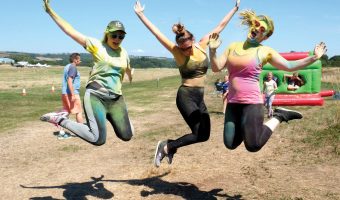
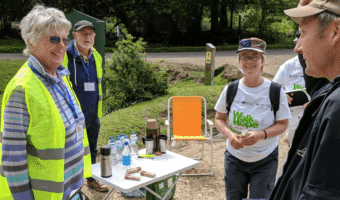
Very quickly I realised I was looking forward to my treatment sessions.
45 stories for 45 years. Throughout 2026, we’re sharing the stories of our clients, volunteers and staff who make the Wessex Cancer Support community what it is.
Through our community’s lived experience of cancer, we can provide our clients with the tailored support they need.
This time Michael, a client at our Bournemouth Centre, shares his story.
In 2025, I got a bit of a sore leg and went to the Doctors. I ended up diagnosed with prostate cancer and the need for two hip replacements. But my story – and how cancer has changed me – really starts back in the 1960s.
As a result of some abusive experiences in my childhood, I wasn’t really able to talk until I was about 15 and I’d become known as “the fat little kid who couldn’t speak”. It was tough. When I left school, I joined the British Army, and then the Foreign Legion, and then took up a series of overseas security postings. By the time I was in my mid-20s, I’d turned into an extremely driven individual who had no time for weakness in others, or in myself. These parts of my life were fueled by fear, but were also installing a great deal of resilience, thought I didn’t appreciate either of these things at the time.
Many years later, in my 50s, I was back in the UK and looking for something new, so I took on some charitable work, including some peer-to-peer mental health. I also decided that I would go back to study something and applied to do a philosophy degree.
As I started handing in assignments, I had an invitation to visit the University at their Milton Keynes headquarters. Naturally, I thought it was because I was brilliant, but the University had other ideas. “We’ve seen work like yours before,” they said, “and we think we know what the problem is.” I was diagnosed with Complex PTSD and Asperger’s.
As a result of all of this – learning about myself, learning more about philosophy and human nature as well as working with those charities – I could see that, slowly, my attitude to life was beginning to change.
That was when I got the sore leg and went to my GP; I was scheduled to start radiotherapy early in the new year 2026. I’d say I was still a bit of a ‘hard arse’ at that point, still thinking I was tough, and then life dealt me a week you couldn’t make up. In the same week, I had two good friends dump me, I broke down in the middle of nowhere, an old Legion friend and his sister (an ex of mine) both died on the same day, I got a speeding ticket, I ended up in hospital after a fall in the shower and I was suspended from work on medical grounds.
Now, I can laugh at the catalogue of disasters but, at the time, I don’t think I’ve ever been lower. Conversations with my GP and mental health services started with questions about whether I was thinking about ending my own life. I didn’t have many people left who I trusted and I was about to start radiotherapy alone. Things weren’t great.
But then I started attending radiotherapy sessions and met people who were genuinely kind and whose only interest was in helping me. Going into the oncology department, the person on reception would ask how I was and genuinely mean it.
Very quickly I realised I was looking forward to my treatment sessions.
I had 20 sessions and they gave a real structure to my day. I’d get up, get properly dressed, go into the hospital and have a coffee, chat to some nice people, have my treatment, perhaps have another coffee afterwards and go home. I found some purpose in it – and the weather was terrible at that point in the year, so I couldn’t go to the beach! When I was in the hospital I did realise that, compared to some, I had been lucky.
As my treatment went on, I spoke to some support groups, including Wessex Cancer Support. I’ve met some very ordinary, very normal people here who display extraordinary courage; the staff, volunteers and other clients I’ve been privileged to meet. I have realised that courage isn’t loud or in your face, it just says “How are you doing? Would you like a cup of tea?”
There’s been a lot of focus on prostate cancer and male cancers in general over the last few years. But I was finding, most of the times I’d go into my local Wessex Cancer Support Centre, I’d be the only guy there. I think women are much tougher than men often; they seem more equipped to cope. Men would rather not know, they would shy away from a diagnosis.
So, when I’ve finished my treatment and recovered, I hope I will be some use to help get the word out, specifically to men. Hopefully – because of my military background – people will see me as a proper man who is accepting help.
I’ve learnt that courage isn’t about shouting and screaming, sometimes it’s being courageous enough to accept help. And I hope my example will be useful.
As we speak, I’ve had one hip replacement already and await the second. (The operation went well but I had a virulent stomach bug while I was in hospital afterwards: I’ll leave you to imagine the kindness and empathy of the staff coping with a bedridden, exhausted, vulnerable man and multiple bed pans….) I’ve also been called in for a colonoscopy to investigate something there, so we’ll see what that turns out to be.
But, believe it or not, I am a lot happier now than I was a year ago. I’m 66 and I’m humbled by the people I’ve met who have been through an experience like cancer with good grace and just got on with it.
And cancer’s the world’s greatest ice breaker; you can talk to any woman in the world and you’ll immediately get a heartfelt response.
Going through cancer is one of the ultimate experiences in this life which helps create who you are. One of the things I’ve discovered, by way of philosophy and my military background, is that people really only do things for two reasons, either fear or love. When you go through something terrible, like cancer, you realise that everyone in organisations like Wessex Cancer Support is only doing what they do for one reason – and it’s not fear.
Our community provides a safe, supportive space for people affected by cancer. Through our emotional and wellbeing services, we provide the support to our communities in Dorset, Hampshire and the Isle of Wight.
We’ve been here for you since 1981.
You can call or email your local cancer support centre today, or drop in to speak to our friendly team.
And if you would like to learn more about volunteering and becoming part of #TeamWessex, you can find out more and apply here.